
How We Find Relatedness in Complex Data, and Then Act On It
Data rarely arrives connected. A sensor reading here, a work order there, a forecast somewhere else. Here is how Feathergrid works out what belongs together, including the graph method it uses, and why that only matters if it leads to your next move.
Feathergrid works out which of your readings, records and events belong together, then tells you what to do about it. It relates things by time, by place, by what tends to lead to what, and by patterns it has seen before. Under the hood, it uses graph methods, including Node2Vec, to learn those connections from your own data.
Here's what that means, and why it matters.
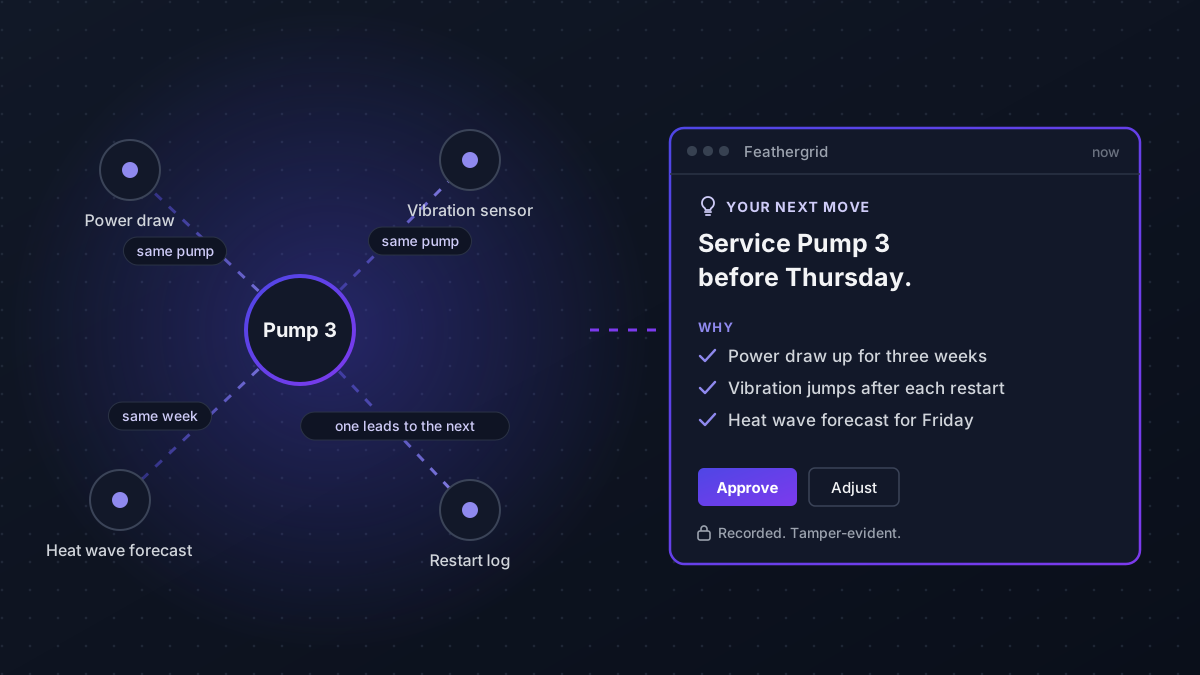
Tap the diagram to open it full size.
Why is relatedness the hard part?
Because data rarely arrives connected.
A pump's vibration reading lives in one system. The work order for that pump lives in another. The heat wave forecast lives in a third. Each one makes sense on its own. The story only shows up when you see that they're about the same pump, the same week, and the same risk.
Storing data is easy. Knowing what belongs together, quickly enough to act, is the hard part.
What makes two things related?
Feathergrid looks for four kinds of connection:
- Same time. Readings and events that move together.
- Same place. Things at the same site, zone, line or vehicle.
- One thing leading to the next. A pressure drop that tends to come before a failure.
- A pattern it has seen before. This combination last showed up before a loss.
No one of these is enough on its own. Two things can happen at the same time by coincidence. Together, they make a much stronger case.
Feathergrid works out which of your readings, records and events belong together, then tells you what to do about it.
What is Node2Vec, and why use it?
Node2Vec is a well-known method for learning from connections.
Picture your operation as a map of dots and lines. The dots are things: sensors, assets, sites, orders, people, events. The lines are the links between them: this sensor is on that pump, that pump is at this site, this work order was raised for that pump. Node2Vec takes many short walks across that map and learns which dots tend to show up near each other.
The result is that things with similar connections end up close together, even if their raw data looks nothing alike. Two pumps at different sites that keep failing in the same way end up close. So do a cooler and the delivery route that keeps feeding it late.
It's useful because it learns from how your operation is actually connected, not from a rulebook someone has to write and keep up to date.
Can you trust a connection a machine found?
Only if you can see why it was made.
That's why Feathergrid never hands you a bare score. Every recommendation shows its reasons: the readings, records and events behind it, and how often recommendations like it have been right before. If the reasons don't hold up, you'll see that before you act.
Why does relatedness only matter if it leads somewhere?
Because a connection nobody acts on is just a more interesting chart.
The point of finding what's related is to tell you your next move, like "service Pump 3 before Thursday" or "launch the drone at 6 a.m., north field first", with the reasons attached. Then your rules decide what happens. Feathergrid acts on its own only where you've chosen that:
- Routine steps run on their own. You choose which ones.
- Big calls wait for a person.
- One switch stops everything.
Every recommendation, approval and action goes on Feathergrid's tamper-evident record.
Where does this show up?
Everywhere Feathergrid works:
- Field equipment. Vibration, heat and work orders that add up to a failure. See field equipment.
- Agriculture. Soil, weather and field history that add up to a launch window. See From Sensor Trigger to Drone in the Air.
- Cold chain and food service. Cooler readings, deliveries and staffing. See all use cases.
The short version
Feathergrid finds what belongs together by time, place, sequence and pattern, and uses graph methods like Node2Vec to learn it from your own data. Then it tells you your next move and why. Your rules decide the rest.
See how it works or book a scoping call.
Topics