
The Power of the Split Ledger
Why anchoring your data across two independent cloud ecosystems — Azure and AWS — creates a class of tamper-proof data integrity that no single-cloud platform can match.
There is a quiet assumption baked into almost every enterprise SaaS platform on the market: that the vendor's cloud is trustworthy enough to be the sole custodian of your historical record.
That assumption is wrong — not because cloud providers are untrustworthy, but because any single point of custody is a single point of failure. A database administrator with root access. A misconfigured backup policy. A nation-state actor with a zero-day. A vendor acquisition that changes the terms of your data relationship overnight.
The split ledger is our answer to that assumption. Here is how it works, and why it matters.
What "Split Ledger" Actually Means
Most people hear "blockchain" and picture a public chain like Bitcoin or Ethereum — slow, expensive, and built for trustless environments where participants don't know each other.
Feathergrid uses Hyperledger Fabric, a permissioned, enterprise-grade distributed ledger framework. It is not a public chain. It is a private, high-performance network where every participant is known, authenticated, and operating under a defined governance model. Throughput is measured in thousands of transactions per second, not the handful-per-second ceiling of public chains.
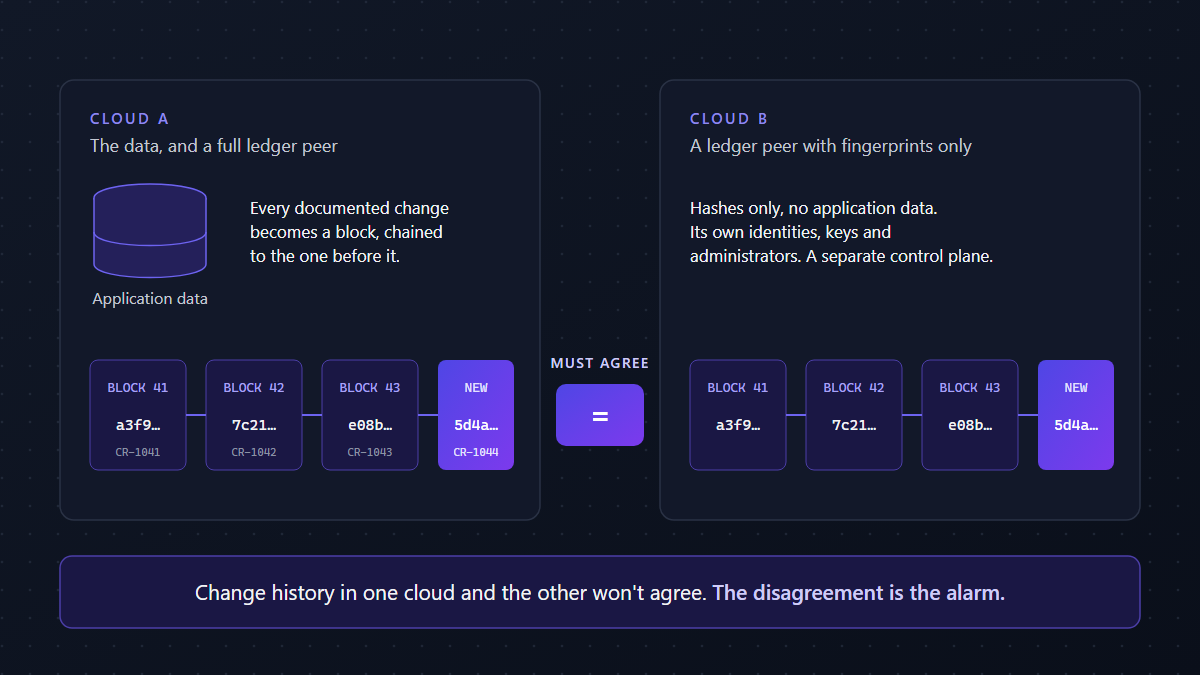
The "split" refers to how we deploy the Fabric network itself. Rather than running all ledger nodes inside a single cloud provider's infrastructure — which is what every other enterprise platform does — we deliberately span the network across two completely independent cloud ecosystems:
- Microsoft Azure hosts the primary application workload, the SaaS control plane, and the primary Fabric peer and orderer nodes. This is where your data lives, where your users authenticate, and where the action tier executes.
- AWS GovCloud hosts a secondary Fabric peer — and nothing else. No application code. No user profiles. No PII. Only cryptographic verification infrastructure.
The two sides communicate exclusively over mutual TLS (mTLS), and the only data that crosses the boundary is anonymized transaction hashes — mathematical fingerprints of your records, never the records themselves.
Why This Architecture Is Fundamentally Different
The Single-Cloud Problem
When a SaaS vendor stores your data in a single cloud database, the security model is essentially: trust us, and trust our cloud provider.
That is a reasonable ask for most operational data. It is not a reasonable ask for your immutable historical record — the audit trail that proves what happened, when, and who authorized it.
A database administrator at the vendor can edit records. A compromised credential can alter logs. A court order in the wrong jurisdiction can compel disclosure. A cloud provider outage can make your history temporarily inaccessible — or permanently lost if backups were misconfigured.
None of these are hypothetical. They happen.
The Split Ledger Solution
When your transaction history is anchored across two independent cloud ecosystems, the attack surface for any of those scenarios collapses dramatically.
To alter a record, an attacker would need to simultaneously compromise both Microsoft Azure and Amazon Web Services — two separate organizations, two separate security teams, two separate physical infrastructure stacks, operating under two separate legal jurisdictions. This is not a harder version of the same problem. It is a categorically different problem. It is, for practical purposes, mathematically impossible.
To corrupt your history through an insider threat, a bad actor would need privileged access to both clouds at the same time. The AWS side has no application code, no user data, and no administrative surface beyond the Fabric peer itself. There is nothing there to compromise except the cryptographic check-engine — and compromising that without simultaneously compromising Azure produces an immediate consensus failure that the system detects and alerts on automatically.
To recover from a conflict, Feathergrid doesn't wait for someone to notice. If the record and the ledger are in conflict, Feathergrid triggers a rollback to the backup database.
There is a quiet assumption baked into almost every enterprise SaaS platform on the market: that the vendor's cloud is trustworthy enough to be the sole custodian of your historical record.
The Compliance Angle
Here is the part that matters most to regulated industries: AWS holds only hashes, never application data.
Because AWS receives only anonymized hashes — never PII, never application data, never anything that constitutes a regulated record — it is treated as an external cryptographic check-engine. It does not need to be included in your compliance boundary. It does not generate audit findings. It does not require its own authorization package.
The result is that you get defense-grade data survivability while cutting regulatory audit friction roughly in half compared to a dual-cloud deployment that actually runs application workloads on both sides.
For organizations operating under FedRAMP, CMMC, HIPAA, or SOC 2, this is not a minor operational detail. It is a meaningful reduction in the cost and complexity of maintaining your authorization.
To be plain about where we stand: Feathergrid is not FedRAMP authorized today. Our founder has taken architectures through HIPAA and FedRAMP High audits.
How the Ledger Actually Works
Every transaction that flows through Feathergrid — every action taken, every signal processed, every approval recorded — generates a cryptographic hash. That hash is a fixed-length fingerprint of the transaction data. Change a single character in the underlying record and the hash changes completely.
Those hashes are written to the Hyperledger Fabric ledger as immutable blocks. The ledger is append-only: you can add new blocks, but you cannot modify or delete existing ones. The chain of hashes creates a mathematically verifiable sequence — if any block in the chain has been tampered with, the hash chain breaks and the tampering is immediately detectable.
Because the ledger is replicated across both the Azure and AWS peers, both sides must agree on the state of the chain. Any discrepancy between the two peers triggers an automatic consensus failure alert. There is no silent corruption. There is no way to alter the record on one side without the other side immediately detecting the divergence.
Self-Healing in Practice
The self-healing property deserves more attention than it typically gets in architecture discussions.
Traditional database replication is synchronous or near-synchronous: if the replica falls behind, you have a replication lag problem that requires human intervention to diagnose and resolve. If the replica is corrupted, you typically need a database administrator to restore from backup — a process that can take hours and introduces its own risk of data loss.
Feathergrid handles it differently. If the record and the ledger are in conflict, Feathergrid triggers a rollback to the backup database. No one has to notice the problem first, and no one has to decide which copy to trust. The conflict itself is the trigger.
What This Means for Your Data
The practical implication is straightforward: your historical record is no longer a single vendor's promise. It is a cryptographically enforced, multi-cloud, self-healing fact.
You can audit any transaction in your history and verify that it has not been altered — not by us, not by a cloud provider, not by anyone. The math is the guarantee, not the contract.
For organizations that operate in environments where data integrity is not just a compliance checkbox but a genuine operational requirement — financial services, defense, healthcare, critical infrastructure — this is the architecture that matches the threat model.
The split ledger is one component of Feathergrid's broader asymmetric boundary defense architecture. If you want to understand how it fits into the full stack — from the SaaS control plane to the edge deployment model — the architecture page walks through the complete topology, and Feathergrid on Azure and AWS covers what runs where.
Topics