Our AI Is a Genius. We Have a Rule About Geniuses.
What responsible AI looks like when you're regulated
In every AI conversation at a regulated business, someone eventually asks who's accountable when it gets something wrong. Here's how we answer that at Feathergrid: five habits built into the platform, why regulators care about them, and how AI earns more responsibility one small step at a time.
If you work in a regulated business, you've probably sat through this meeting. Everyone is excited about AI, the demo looks great, and then someone at the end of the table asks the question nobody planned for:
"Who's accountable when it gets something wrong?"
It's the right question. In healthcare, finance, food safety or government, "the model did it" isn't an answer.
The good news is that you don't have to choose between moving fast and staying in control. At Feathergrid, responsible AI isn't a single feature or a policy on a shelf. It's a handful of habits built into the whole platform.
Five habits of responsible AI
- You decide what runs on its own. Some actions are routine; others need a person's judgment. You draw that line, and you can redraw it anytime. We call this governed autonomy.
- Every suggestion explains itself. Each recommendation shows why, and how often that kind of call has been right before.
- People stay in charge. Anything that needs judgment goes to the right person, and one switch stops everything.
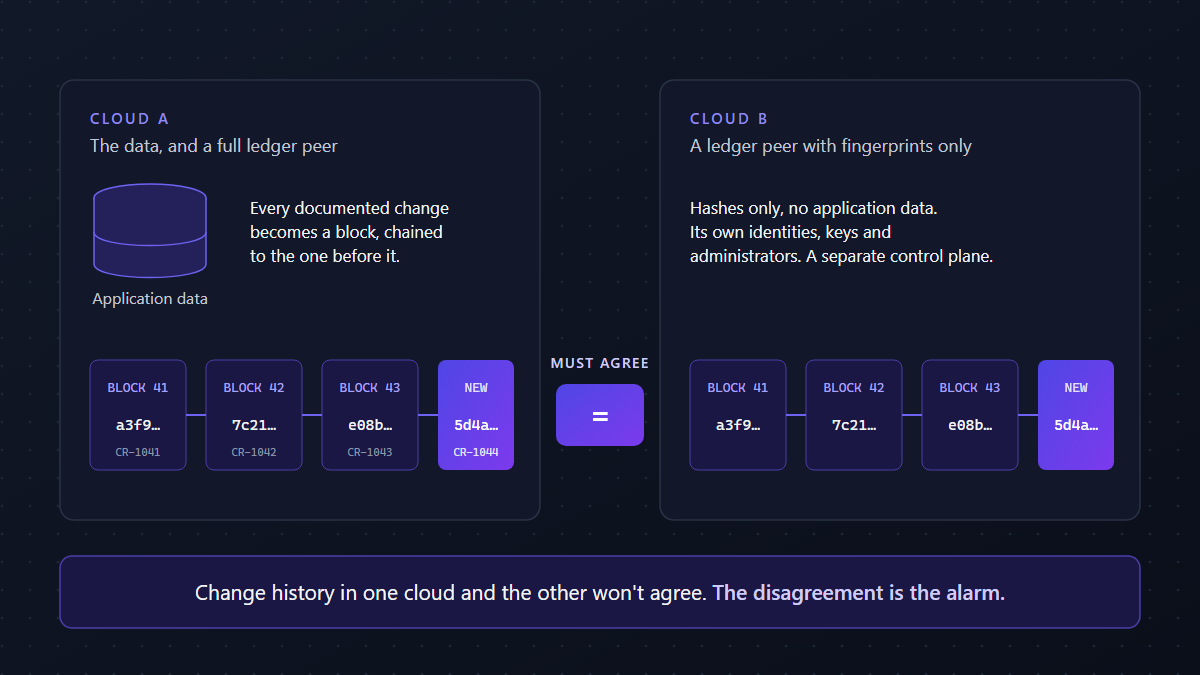
- Everything is on the record. Every action, automatic or approved, is written to a split ledger: a tamper-evident record kept across two clouds under separate control, so no one can quietly rewrite it, administrators included. (Why we built it that way)
- Your data stays yours. It's processed in the US and never used to train AI models, and every privileged action is checked each time.
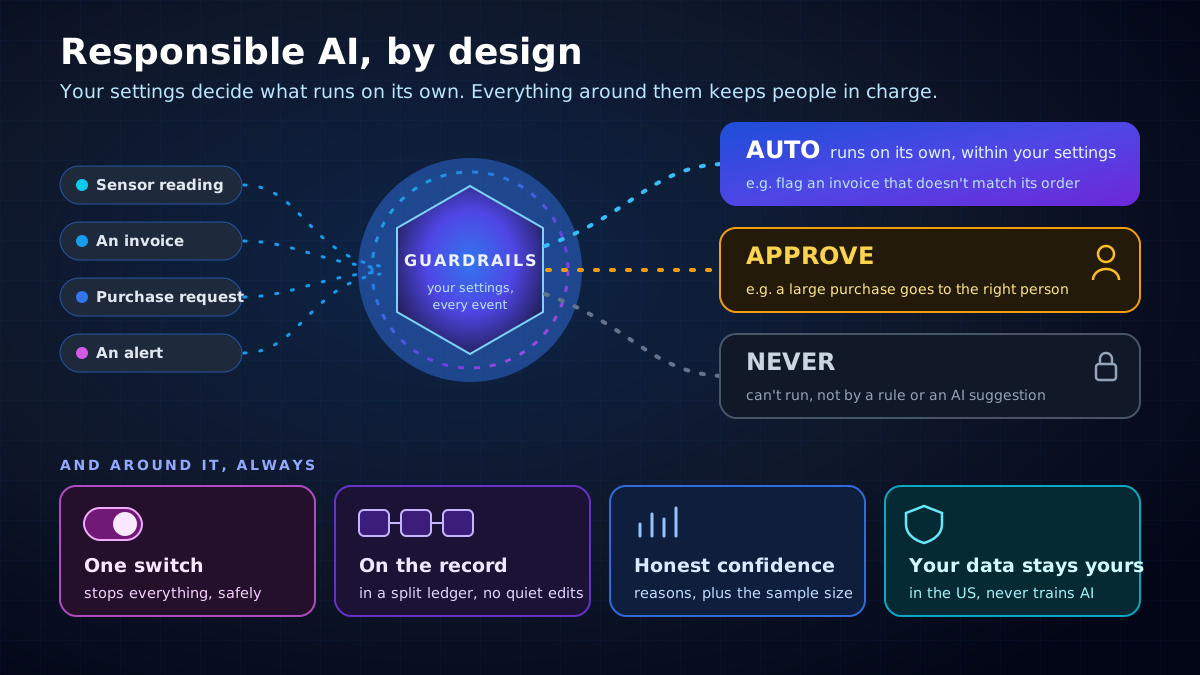
Tap the diagram to open it full size.
On their own, none of these ideas are new. What matters is having all five working together, all the time.
Why regulators care
Regulators rarely tell you not to automate. What they want is accountability you can show:
- Healthcare: HIPAA requires mechanisms "that record and examine activity in information systems that contain or use electronic protected health information" (45 CFR 164.312(b)).
- Life sciences: the FDA's Part 11 calls for "secure, computer-generated, time-stamped audit trails" (21 CFR 11.10(e)).
- AI in Europe: from December 2027, the EU AI Act will require that people can interrupt high-risk AI systems "through a 'stop' button or a similar procedure" that brings them to a safe halt (Article 14).
The wording differs, but together they ask for three things: know what the system is allowed to do, show what it did, and be able to stop it.
The middle one is where most systems fall short. A record your own administrators can edit isn't evidence. That's why ours is a split ledger.
The wording differs, but together they ask for three things: know what the system is allowed to do, show what it did, and be able to stop it.
Governed autonomy
When teams bring AI into their work, they tend to land in one of two places.
The first is autopilot with no rules. The AI moves fast, but no one can say afterward what it was allowed to do or why. That works until the first bad call.
The second is a person approving everything. It feels safe, but when every action needs a sign-off, people stop reading what they sign. Approvals become reflexive clicks, and you've built an expensive rubber stamp.
Governed autonomy sits in between. It's our rule about geniuses: each kind of action gets one of three settings, and Feathergrid's guardrails apply them to every event as it arrives.
- Auto: it happens on its own, within your settings, like checking every invoice against its purchase order and flagging the ones that don't match.
- Approve: it goes to the right person, with the reasons attached, by text if they're away from their desk. A purchase over your spending limit is a good example.
- Never: it doesn't happen, no matter what asks for it.
Routine work runs on its own, judgment calls go to people, and you can move any action from one setting to another as your confidence grows.
Earned, one step at a time
Trust should be earned gradually, by software as much as by people. We build Feathergrid that way: in small, complete pieces, each tested before it ships, with every important decision written down. The platform lets you extend trust the same way.
Here's what that looks like for something almost every business does: keeping supplies in stock.
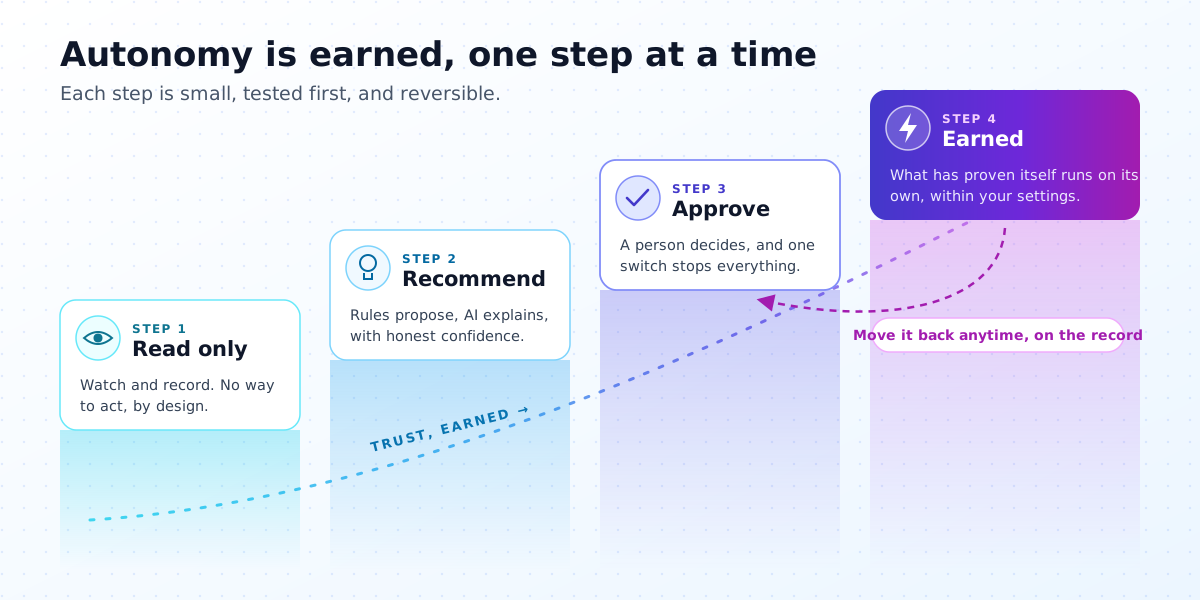
Tap the diagram to open it full size.
Read only. You connect your inventory and sales systems, and Feathergrid starts watching and recording. That's all it can do: the connection only reads.
Recommend. When something is about to run low before a busy stretch, Feathergrid looks at what's related, such as recent sales, the calendar and how long deliveries take. Then it recommends a next step, with its reasons and its track record, and texts it to the person responsible.
Approve. That person approves, adjusts or dismisses the recommendation. Anything that would change something in your systems waits here for a person.
Earned. Raising an alert when stock drops below its limit happens on its own. Nobody needs a meeting to be told they're running out. The goal was never to automate everything; it's that every setting is a deliberate choice, backed by evidence, that you can change.
The same steps work in more sensitive places. If you use Feathergrid's trading tools, for example, they can watch the markets you choose and flag what fits your own strategy, but placing an order always stays with you.
Behind the scenes, every new kind of action starts switched off or in "approve", the stop switch stops new actions and brings everything to a safe halt, and a software update never overrides a choice someone made on purpose.
A rhythm for your team
Whatever tools you use, here's a rhythm that works:
- Start every new kind of action in "approve" and let a track record build.
- Review it like a sprint: how often was it right, and what did people change?
- Move it to "auto" only with that evidence, written down, with a named owner.
- Keep the stop switch close, and move an action back the moment something changes.
Small steps, honest feedback, nothing you can't undo. That's how trust is built, with people and with software.
Six questions to ask any AI vendor
- What can it do on its own today, and who decided that?
- Can I change that for each kind of action without waiting for a new release?
- What happens to anything outside the rules?
- Where's the stop switch, and how quickly does it work?
- Can anyone, including your administrators, change the record afterward without it showing?
- When it says it's eighty percent confident, eighty percent of what, out of how many?
Vague answers usually mean vague governance.
The short version
Responsible AI is one part of what Feathergrid does. The bigger job is bringing your data together into one live picture of your operation, so the next move is clear. Responsible AI is what lets you trust that picture when the stakes are real.
Routine work runs on its own, people focus on the decisions that deserve them, and when someone asks "who decided?", the answer is already written down.
That's what a responsible AI shop ships.
Topics